
When the Pi House Rocked: A Musical Tradition Spanning Generations at Cornell
From bringing Bo Diddley to the Pi house to alumni making music together at Reunion, Mu Chapter of Sigma Pi has spent more than six decades bringing people together through music.
Long before massive concerts became a defining feature of Cornell’s end-of-year celebrations, live music was already echoing across West Campus from the front porch of the Sigma Pi house.
For generations of Cornellians, 730 University Avenue has been a fraternity house, a home, a gathering place, and, at times, one of the most memorable stages on campus.
The story of music at the Mu Chapter of Sigma Pi is more than a collection of concerts and bands. It is a story about how music creates community. It is about the changing soundtrack of college life. And, increasingly, it is about how a shared love of music can connect Cornell alumni who graduated decades apart.
Today, that tradition continues through a growing group of Sigma Pi alumni musicians and singers who come together during Cornell Reunion as a Band of Brothers.
But, the story began in the 1950s, when rock and roll itself was still something new.
When Rock and Roll Came to the Pi House
By the mid-1950s, jazz had long been a fixture of college social life. Rock and roll, however, was just beginning to reshape American culture.
Brother Bruce A. Clark ’57, known to his fraternity brothers as “The Gamma Geetus,” believed Sigma Pi needed to make a bigger mark on Cornell’s social scene. Many of the chapter’s prominent athletes had graduated, and Clark saw an opportunity for Mu Chapter to become known for something different. His idea was simple; make the Pi house the place to go for live music.
During Cornell’s Spring Weekend, the front porch of 730 University Avenue became a stage. Students packed the front lawn, filled the area across the street, and gathered wherever they could hear the music.
The performances became part of a much older Cornell tradition. Since the first recorded Spring Day in 1901, Cornell students had celebrated the end of winter and the arrival of warmer weather through outdoor gatherings, performances, parades, and other festivities. Over the decades, those traditions would evolve through Spring Fest and eventually into the modern Slope Day. At Sigma Pi, spring celebration increasingly meant rock and roll.
The exact details of those earliest concerts have been blurred by time. Alumni recollections mention bands with names such as “Portuguese Pete” and “Jimmy Cavallo.” But one performance is firmly embedded in Mu Chapter lore.
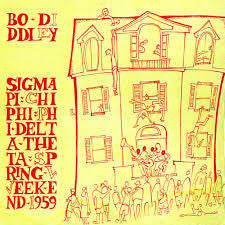
In 1959, Sigma Pi brought the future Rock and Roll Hall of Famer Bo Diddley to the Pi House.
The price of bringing Diddley to Ithaca was more than Sigma Pi could afford alone, so the chapter partnered with neighboring fraternities Phi Delta Theta and Chi Phi to make the concert possible.
The performance was recorded live, and records were pressed and sold afterward. The album jacket, designed by Mu Chapter alumnus M. Perry “Pert” Chapman, features a cartoon drawing of the Pi house with brothers having fun and a band blaring on the front porch.
“Bruce Clark, our social chairman, came up with the idea of hiring Bo Diddley and his band for a Spring Weekend party,” John Hax ’59 later recalled. “At the time, he was known to people who liked rock but was not the icon he soon became.”
For Mu Chapter, it was only the beginning.
Rock and Roll Tea
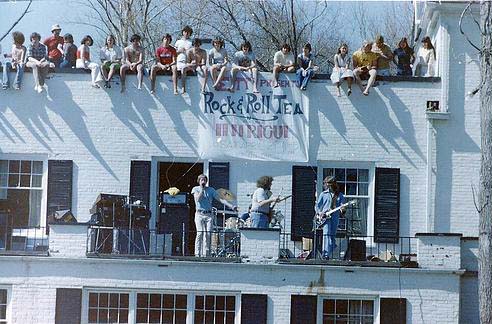
In the years that followed, live music became increasingly intertwined with the identity of the Pi house. Every spring, while some fraternities hosted the more traditional “faculty tea,” Sigma Pi developed a tradition with a distinctly different personality: Rock and Roll Tea.
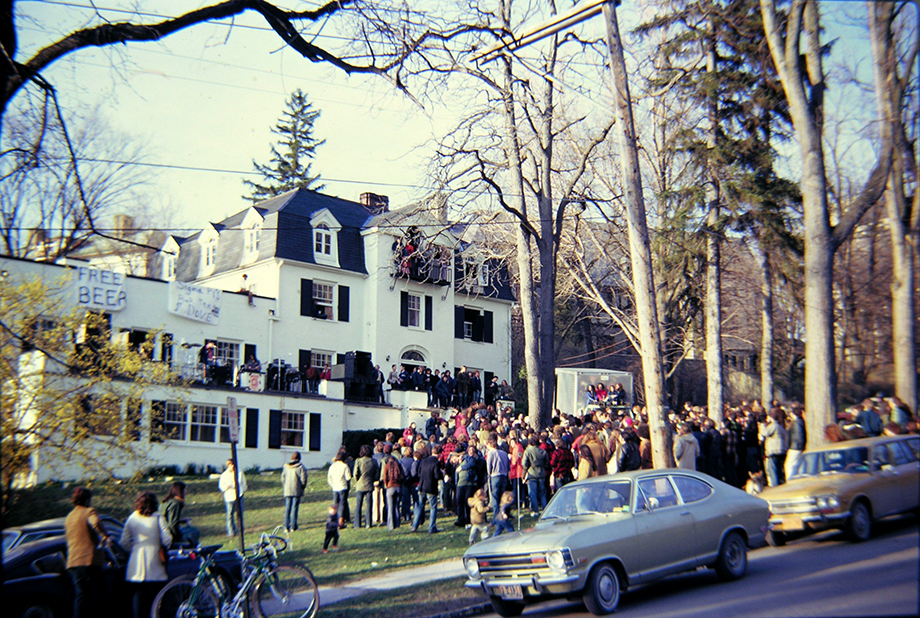
On a Saturday afternoon, a band would perform from the house while music spread across West Campus. Students gathered on the lawn, across the street, around the house, and even on the roofline above the Pi house beach. The crowds could be enormous.
Photographs from the era show hundreds of students filling the area surrounding 730 University Avenue. Brothers and guests lined the roof. Musicians performed against the unmistakable backdrop of the house. The result was part concert, part spring celebration, and part uniquely Cornell spectacle.
Rock and Roll Tea became a recurring feature of Mu Chapter life and placed the chapter within Cornell’s broader tradition of celebrating the arrival of spring through music and community.
Years later, Cornell would formalize large-scale spring concerts as part of the modern Slope Day. But, generations of Mu Chapter brothers already understood the formula: warm weather, the end of the academic year, hundreds of Cornell students, and live music loud enough to bring everyone together.
Music Beyond the Spring
The chapter’s musical traditions were not limited to one weekend.
In the fall of 1960, Social Chairman Ed Butler ’63 helped create another event that would become a long-running Sigma Pi tradition: Hurlothrumbo.
The first Hurlothrumbo was conceived as an afternoon gathering with a live rock band. Its unusual name, chosen for its association with ghosts and otherworldly things, helped give the event its own identity. The chapter promoted it enthusiastically across campus, and the tradition continued for years.
Hurlothrumbo also produced one of the more remarkable personal stories in Mu Chapter history. Walt Laessig ’63 and Ed Butler ’63 both met their future spouses at the inaugural event. Fifty years later, the two couples returned to the Pi house together.
It is a reminder that the significance of these events was never limited to the music itself. People met. Friendships formed. Relationships began. Memories became stories that alumni would tell decades later. That is what music has always done at 730 University Avenue.
When the Musicians Were Brothers
Eventually, Sigma Pi was not only hosting bands. The brothers became the band.
In the 1970s, Zoltan emerged as one of Central New York’s popular hard-rock bands. Most of its members were Sigma Pi brothers, and the group performed music by Led Zeppelin, Jethro Tull, Queen, Santana, and other major artists of the era, along with original material.
The band included Sigma Pi brothers Sandy Kraker ’74, Mark Cunningham ’75, Reber Carroll ’75, Tom Garr ’76, and Peter Phillips ’75, along with Ithaca College musician Curt Bolak ’75.
Zoltan performed at fraternity parties, including the Rock and Roll Tea, but its reach extended far beyond Cornell. The band played more than 400 gigs throughout the Northeast and Canada. For a generation of Mu Chapter brothers, Zoltan became part of the soundtrack of their Cornell years. Decades later, the music brought them home.
The band reunited for memorable performances at the Pi house in 2003 and 2006. The reunions drew brothers from the 1970s and 1980s back to 730 University Avenue, demonstrating something that has become increasingly important to Mu Chapter:
The bonds created through music do not disappear at graduation.
A New Band of Brothers
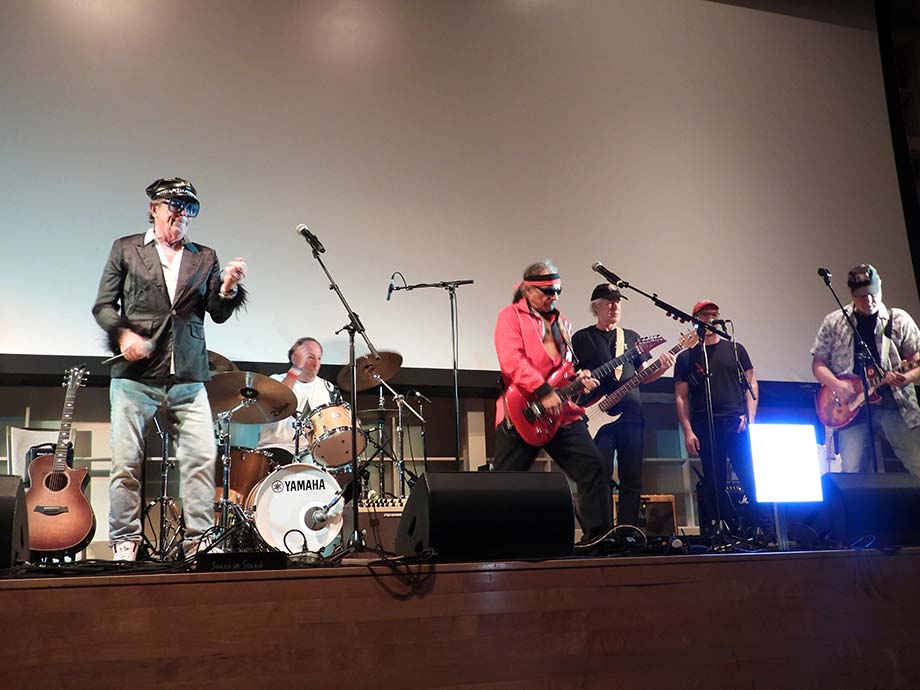
Today, Mu Chapter’s musical tradition is entering another chapter.
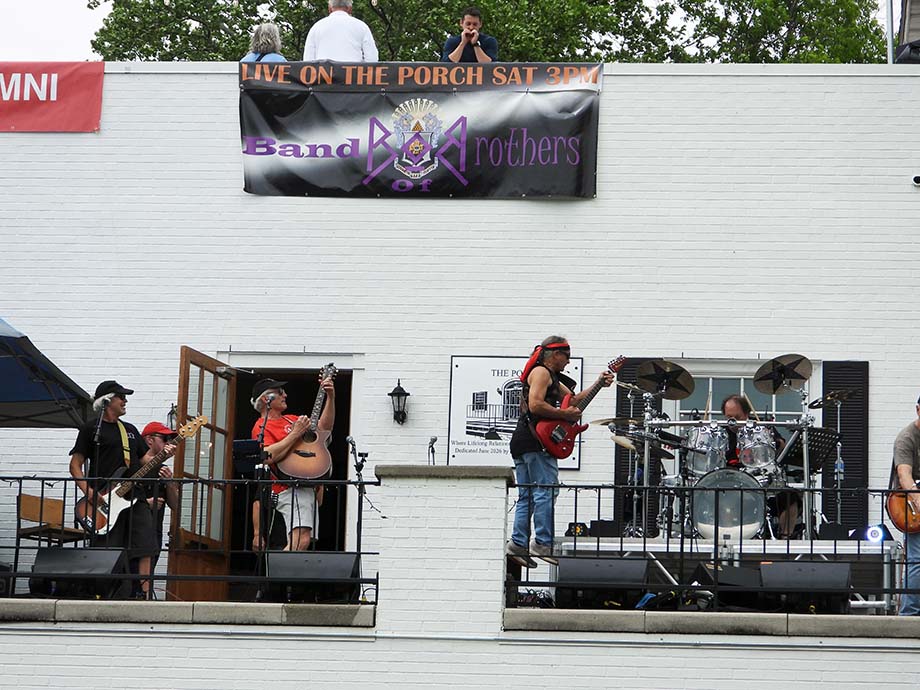
At Cornell Reunions, alumni musicians and singers are once again gathering at the Pi house not simply to remember the music of their college years but to make music together.
The Band of Brothers brings alumni from different class years and musical backgrounds together for live performances during Reunion Weekend. A brother who played guitar in college can share a stage with someone who graduated decades earlier or later. A singer who has never met the drummer before Reunion can discover that they know the same songs.
The result is something uniquely powerful. Most alumni organizations spend considerable time asking how to bridge generations. Music does it naturally. A song can instantly transport one alumnus back to a packed Rock and Roll Tea while introducing another to a chapter tradition that existed long before he arrived at Cornell. The musicians might have lived at 730 University Avenue in different decades, but when they begin playing together, the class years matter much less.
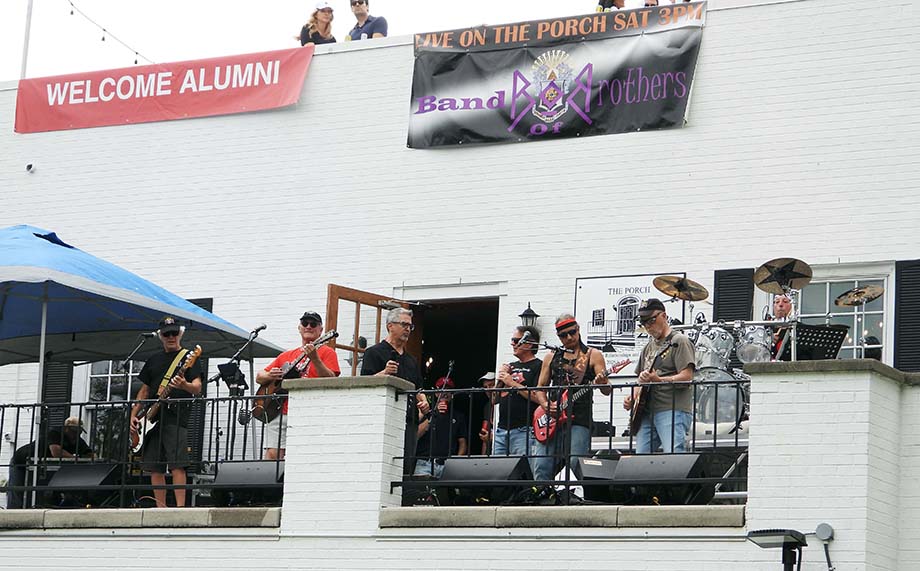
They are simply brothers making music. And, the invitation is growing. Mu Chapter is actively looking for alumni of all ages who are musicians or singers to become involved with the Band of Brothers at future Cornell Reunions. Whether someone performed professionally, played in a college band, sings regularly, or simply wants to pick up an instrument again, the goal is to expand the tradition and create new opportunities for alumni to connect through music.
The next great Mu Chapter band might not come from a single graduating class. It may span half a century.
More Than Nostalgia
It would be easy to view Mu Chapter’s musical history as nostalgia: a collection of old photographs, concert stories, album covers, and memories of crowded spring afternoons.
But, the larger story is about continuity.
Cornell’s spring traditions have changed dramatically since the first Spring Day in 1901. Spring Day became Spring Fest. Spring Fest evolved through periods of change and eventually into the modern Slope Day, with major artists performing for thousands of students.
Music changed, too.
Jazz gave way to early rock and roll. Bo Diddley helped redefine popular music. Hard rock filled fraternity houses in the 1970s. Bands like Zoltan created their own following. New generations arrived with new songs and new sounds.
Through it all, the Pi house remained a place where music brought people together. The front porch that once served as a stage still stands. The photographs remain. The stories continue to be told. And at Reunion, guitars are plugged in, microphones are turned on, and brothers who might have graduated decades apart find a common language.
For more than six decades, music has been woven into the story of Sigma Pi at Cornell. The next verse is still being written.
Call for Musicians: Join the Band of Brothers
Did you play in a band at Cornell? Do you still play an instrument or sing?
The Mu Chapter of Sigma Pi is building a growing network of alumni musicians and vocalists to perform together as the Band of Brothers during Cornell Reunion Weekend.
We are looking for brothers from every generation and every level of musical experience. Guitarists, bassists, drummers, keyboard players, horn players, singers, and other musicians are all welcome.
Whether you once played at the Rock and Roll Tea, performed in a Cornell-area band, picked up music after graduation, or simply want to make music with your brothers, we want to hear from you.
E-mail: b.finneran@iecgny.com